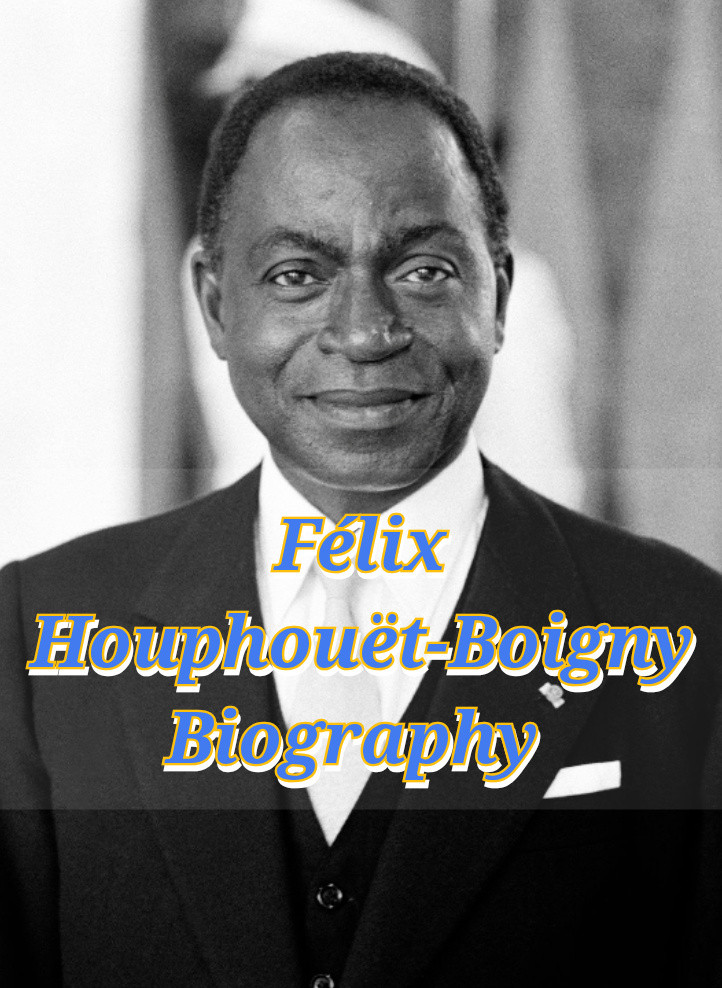
Félix Houphouët-Boigny Biography: Personal Life, Family, Early Life, Age, Education, Career, Achievements, Net Worth
Félix Houphouët-Boigny Biography
Félix Houphouët-Boigny was born Dia Houphouët on 18 October 1905 in Yamoussoukro, French West Africa (now Côte d’Ivoire). He held Ivorian nationality and became the first President of Côte d’Ivoire, serving from independence in 1960 until his death in 1993.
Known affectionately as Papa Houphouët or Le Vieux, he transformed Côte d’Ivoire into one of the most prosperous nations in sub-Saharan Africa through pragmatic policies, close ties with France, and focus on agricultural exports. A former tribal chief, medical aide, union leader, and planter, he navigated colonial politics to lead his country for over three decades, earning recognition as the Sage of Africa for his moderate approach and role in decolonization.
Félix Houphouët-Boigny Early Life
Félix Houphouët-Boigny entered the world on 18 October 1905 in Yamoussoukro, a village in what was then French West Africa. He belonged to a prominent Baoulé family of hereditary chiefs. His original name, Dia Houphouët, carried the meaning of prophet or magician in local tradition. His father, N’Doli Houphouët, was a wealthy cocoa farmer, and his mother, Kimou N’Dri, connected him to royal lineage through Queen Yamousso.
Tragedy struck early when a relative, the village chief Kouassi N’Go, was murdered in 1910. Young Dia was designated to succeed him, but his stepfather acted as regent due to the boy’s age. Houphouët-Boigny had elder sisters and a younger brother. The French colonial authorities recognized traditional leaders and enrolled him in school to prepare him for leadership roles. He attended primary school near his village and later moved to Bingerville. There, in 1915, he converted to Christianity and adopted the name Félix.
He excelled academically and progressed to the prestigious École normale supérieure William Ponty in Senegal, earning a teaching degree. He then studied at the École de médecine de l’AOF in Dakar, graduating in 1925 as a medical assistant, the highest qualification available to Africans at the time. These formative years blended traditional African upbringing with French colonial education, shaping his future as a bridge between cultures.
Félix Houphouët-Boigny Age
Houphouët-Boigny lived to the age of 88. He was born in 1905 and passed away on 7 December 1993. Throughout his long life, he witnessed and influenced major historical shifts, from colonial rule to independence and the challenges of post-colonial governance in Africa.
Félix Houphouët-Boigny Education
His education began in local colonial schools, where he stood out among peers. Transfer to Bingerville exposed him to broader learning. At William Ponty, he earned a teaching qualification before pursuing medical training in Dakar. He qualified as a médecin africain in 1925, focusing on practical healthcare suited to rural African contexts. This background equipped him with skills in administration and empathy for ordinary people, which later informed his political career.
Félix Houphouët-Boigny Career
Houphouët-Boigny started his professional life as a medical aide in Abidjan in 1925. He worked in various postings, including Guiglo, Abengourou, Dimbokro, and Toumodi. In these roles, he observed the exploitation of African cocoa farmers by European settlers. This experience fueled his activism.
In 1944, he founded the Syndicat Agricole Africain (SAA), a union that defended African planters against discriminatory policies. The organization grew rapidly, representing thousands and demanding fair wages and the end of forced labor. His efforts led to the Loi Houphouët-Boigny in 1946, which abolished forced labor across French colonies.
Elected to the French National Assembly in 1945 as a deputy for Côte d’Ivoire, he added Boigny to his name, meaning irresistible force. He co-founded the Democratic Party of Côte d’Ivoire (PDCI) in 1946, affiliated with the broader African Democratic Rally. Initially aligned with leftist groups, he shifted toward cooperation with France in the 1950s to advance Ivorian interests.
He served in multiple French ministerial positions between 1956 and 1960 while leading territorial assemblies in Côte d’Ivoire. As mayor of Abidjan and a key negotiator, he advocated for self-government within the French Community rather than full immediate independence or regional federations that might burden richer territories. Côte d’Ivoire gained independence in 1960, and he became its first president.
As president, he pursued free-enterprise policies emphasizing cash crops like cocoa and coffee. Foreign investment flowed in, and French technical expertise supported development. The Ivorian miracle brought high per capita income and stability uncommon in the region. He maintained one-party rule through consensus and co-optation of opponents. Reelected unopposed multiple times until contested elections in 1990, he remained in power until his death.
Félix Houphouët-Boigny Achievements
Houphouët-Boigny’s achievements include steering Côte d’Ivoire to economic prosperity. The country became a leading exporter of cocoa, coffee, pineapples, and palm oil. Infrastructure improved significantly under his vision. He moved the capital to his birthplace, Yamoussoukro, and commissioned grand projects, notably the Basilica of Our Lady of Peace, one of the world’s largest churches.
In foreign policy, he championed close Franco-African relations, known as Françafrique. He played roles in regional stability efforts and supported anti-communist movements. UNESCO established the Félix Houphouët-Boigny Peace Prize in 1989 to honor his contributions to peace. At his death, he was Africa’s longest-serving leader, recognized globally as a statesman who balanced tradition and modernity.
Félix Houphouët-Boigny Recent News
Decades after his passing, Houphouët-Boigny remains a foundational figure in Ivorian identity. Discussions often revisit his legacy amid contemporary challenges like political transitions and economic diversification. His foundation and the peace prize continue to promote dialogue. Occasional reports highlight debates over his vast estate and the enduring impact of his policies on national unity.
Félix Houphouët-Boigny Personal Life
Houphouët-Boigny led a life marked by public service and private commitments. He converted to Christianity and valued education and healthcare. Known for a soft-spoken demeanor despite his stature, he cultivated relationships across political spectrums. His later years involved grand building projects reflecting both personal pride in Yamoussoukro and national ambition. He enjoyed wealth from plantations and investments while focusing on development.
Félix Houphouët-Boigny Family
He married first in 1930 to Kady Racine Sow, a union notable for bridging Catholic and Muslim backgrounds. They had five children: one who died in infancy, plus Augustine, Francis, Guillaume, and Marie. The marriage ended in divorce in 1952.
That same year, he wed Marie-Thérèse Brou, who became a prominent figure alongside him. Family life intertwined with politics, and his heirs later navigated inheritance matters following his death. His background as a chief influenced a sense of paternalistic leadership toward the nation.
Félix Houphouët-Boigny Net Worth
Estimates of Houphouët-Boigny’s personal wealth at death ranged from 7 to 11 billion US dollars, derived from plantations, real estate in France, Italy, and Switzerland, and investments. He owned properties in Paris and shares in luxury companies. While he lived modestly in public, his fortune reflected the economic success he fostered. Debates over its distribution persisted after his passing.
Conclusion
Félix Houphouët-Boigny shaped modern Côte d’Ivoire through vision, pragmatism, and endurance. From humble medical practice to presidential leadership, he prioritized stability and growth. His era brought the Ivorian miracle but also challenges from over-reliance on commodities and one-party governance. Today, he symbolizes a pivotal chapter in African history, remembered for bridging colonial past and independent future. His contributions to peace and development continue to inspire reflection on effective leadership.
FAQs
What was Félix Houphouët-Boigny’s role in Ivorian independence?
He negotiated self-government within the French Community and became prime minister in 1959 before assuming the presidency upon full independence in 1960. His moderate stance avoided radical breaks while securing autonomy.
How did Houphouët-Boigny contribute to Côte d’Ivoire’s economy?
He promoted agricultural exports, welcomed foreign investment, and maintained strong French partnerships. This strategy elevated living standards and positioned the country as a regional economic leader for years.
Why did he move the capital to Yamoussoukro?
As his birthplace, the city held personal significance. The relocation symbolized national pride and led to major infrastructure like the grand basilica, aiming to decentralize development from Abidjan.
What was the Ivorian miracle under his leadership?
It referred to rapid economic growth through sound policies, cash crop focus, and stability. Côte d’Ivoire achieved high per capita income without oil resources, though later commodity price drops tested this model.
How many times was Houphouët-Boigny reelected as president?
He won unopposed elections in 1965, 1970, 1975, 1980, and 1985, with the first contested vote in 1990. His long tenure reflected strong party organization and political skill.
What is the Félix Houphouët-Boigny Peace Prize?
UNESCO created it in 1989 to recognize efforts in safeguarding peace. It honors his diplomatic legacy and promotes conflict resolution globally.
What happened to Côte d’Ivoire after his death?
The country faced economic difficulties, devaluation, political transitions, and eventual civil conflict. His absence highlighted the importance of succession planning.